
Most companies roll out AI in a matter of weeks today. A few assistants, a few automations, hooked up to SharePoint, the CRM, and a wiki. In the demo, everything works. In everyday use, the answers that come back are half right, invent sources, or miss important documents. The first suspicion usually falls on the model. The next, better GPT is supposed to fix it.
It's rarely the model. Modern language models are excellent at phrasing and reasoning. What they lack is your knowledge: the proposals, the contracts, the project documentation, fifteen years of experience spread across a dozen systems. How an AI reaches this knowledge determines the quality – and costs – of every single answer. And this is exactly the layer missing from most setups: the data layer.
What a Data Layer Is
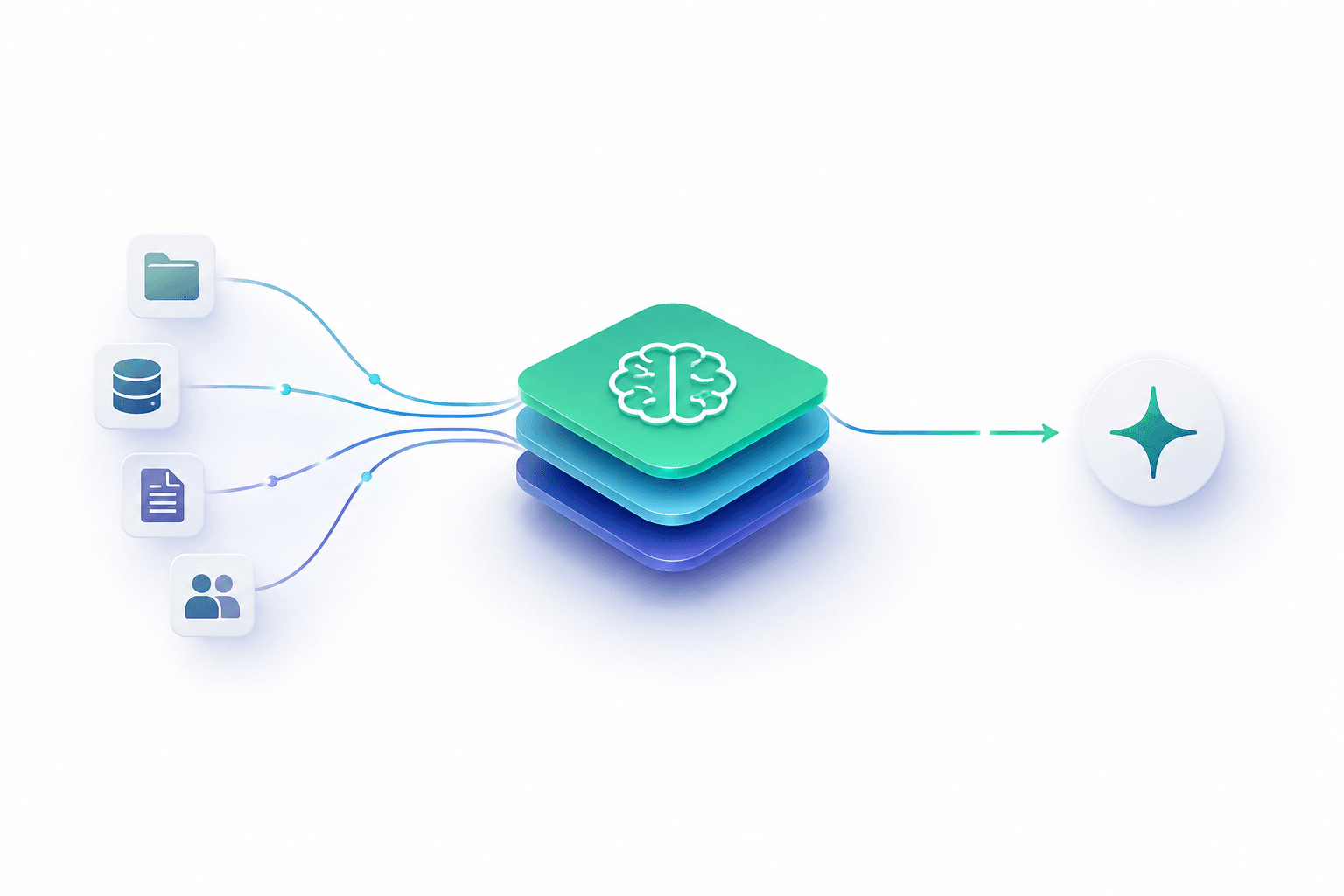
A data layer is the layer between your data sources and your AI. You can think of it as a company brain: a prepared, understood copy of what your company knows. It collects content from all relevant systems, makes sense of it by meaning, and records how things connect. Which version of a proposal is current. Which colleague worked on which project. Which document belongs to which customer, and who is allowed to access it.
Without this layer, every AI flies blind. With each question it is handed a stack of text and has to hope the answer is in there. With a data layer, it reaches straight for the right thing, because the groundwork is already done. It's the difference between a new employee on day one, digging through every archive, and an experienced colleague who knows exactly where the answer is.
Why the Model Alone Isn't Enough
There are essentially three ways an AI can get to your knowledge, and two of them lead to a dead end.
The first: dump everything into the model. Documents are uploaded, and large amounts of text are sent along with every question. Quick to build, but slow and expensive, because you pay for every word. Current documents have to be re-uploaded constantly, and access rights are lost along the way.
The second: search anew with every question (also known as the MCP route, or solved via search APIs). The AI combs through your systems again on every request, often in several passes. The result depends on the search quality of the connected systems, which was rarely built for AI. When retrieval is weak, the AI compensates with even more queries. Each of them costs time and money.
The third way is the data layer: your knowledge is understood once and prepared so that the AI finds the right information immediately, in a single step. More work to build, superior in operation. The first two ways solve the problem for the demo. The third solves it for everyday use.
Argument 1: Quality Comes from Understanding
An AI answer is only as good as the material it's given. Give the model exactly the right content, and it delivers precise results with little noise. Give it an unsorted pile of text, and it produces plausible-sounding half-truths. Hallucinations are often a symptom of poor retrieval, not a pure model problem.
A good data layer opens up content by its meaning and goes beyond pure keyword search. It understands that "notice period" and "contract term" are related, even when the question is phrased differently from the text. And it uses the signals that already exist in your company: which documents are current, who works on what, which content belongs together. Context emerges from these relationships, and context is what separates a useful answer from a dangerous one. And because the data layer refreshes constantly — usually once a day — this knowledge stays current, access rights included; documents that are deleted disappear from the data layer as well.
Argument 2: A Foundation for Everything That Comes Next
Most companies don't stop at a single assistant. The first is followed by the sales assistant, the support agent, the automation in the back office. If each of these systems gathers its knowledge on its own, you build the same problem over and over and maintain the same access rights in a dozen places.
A data layer turns that around. It is the shared knowledge base that everyone draws on: employees through search, assistants for their answers, agents for their tasks. Improve the foundation, and every application on top of it gets better. A company's real AI strategy is rarely the question of which model to pick. It's the question of how good the foundation is that all the models work on. Agents make this even more pressing: an agent that acts, opens tickets, or prepares proposals does more damage on a poor knowledge base than an assistant that only answers.
Argument 3: Your Knowledge Stays Yours
A data layer is the central, prepared copy of what your company knows. That's a crown jewel, and it makes one question important: who can access it in case of doubt, and which legal jurisdiction it sits in.
Anyone hosting on US servers falls under the US CLOUD Act. The US government can compel US providers to hand over data, even when it physically sits in Europe. This applies even if you buy from a German provider that runs on a US cloud in the background or, for example, is owned by a US company (see our blog article on digital sovereignty). With amber, your data layer sits under German sovereignty in Telekom's sovereign T-Cloud. GDPR- and ISO 27001-compliant, with no training on your data. Anyone who wants to keep control of their knowledge has to keep control of the layer that knowledge sits in.
Argument 4: Costs Fall with Usage
Building a data layer costs something up front — but not a fortune. It's a one-time investment in a foundation, not a recurring fee per query. What matters is what happens afterward.
Anyone who searches anew with every question pays more with each request: more search steps, more text through the model, more tokens. That curve points upward for the rest of its lifetime. A data layer behaves the opposite way. The more queries, assistants, and agents draw on the same foundation, the more the one-time investment is spread out, and the lower the cost per answer becomes. The use of AI in companies will grow strongly over the coming years. That's exactly why the architecture you choose today makes the difference tomorrow between predictable and exploding costs.
Want to know how to bend that curve downward in concrete terms? We've put it together for you: our whitepaper shows how to cut the costs of your enterprise AI in a targeted way — and what the implementation looks like, step by step.
Download the whitepaper for free:
How to Recognize a Good Data Layer
Six questions help you assess any offering and any internal project:
- Is my knowledge prepared once, or does the AI search everything anew with every question?
- Does the AI get the right information in a single step, without constant follow-up queries?
- Is content opened up by its meaning, and are the relationships between items mapped?
- Do employees, assistants, and agents draw on the same knowledge base?
- Does my prepared knowledge sit under European control, GDPR- and ISO 27001-compliant, with no training on my data?
- Are access rights preserved across the entire path?
The more often the answer is a clear yes, the more solid your foundation is.
Conclusion
The quality of your enterprise AI is decided on a layer that's rarely talked about: the data layer between your data and the model. It determines whether answers are precise or invented, whether your next assistant starts on a solid foundation or solves the knowledge problem from scratch, whether your knowledge stays with you, and whether your costs fall or rise with usage.
amber builds exactly this layer: a company brain that understands your knowledge once and makes it usable for every AI application — secure and sovereign, from Europe. If you'd like to know what that looks like for your data sources and use cases, talk to us.