

Table of Contents
The most important findings at a glance
- Problem: German companies lose billions every year due to inefficient information searches, knowledge loss as a result of demographic change, and the uncontrolled use of AI tools (shadow IT).
- Definition: Knowledge management is the strategic process of identifying, securing, distributing, and efficiently utilizing all of a company’s knowledge.
- Business case: Effective knowledge management increases productivity by up to 30%, promotes innovation, and minimizes operational risks.
- Evolution: Modern knowledge management solutions do not replace systems, but rather connect them intelligently. AI technologies such as Retrieval-Augmented Generation (RAG) are the key.
- Implementation: Successful implementation follows a 6-step roadmap that ranges from strategy to pilot project to change management.
- Solution: amberSearch offers an AI-powered platform that acts as an intelligent access layer to all your corporate knowledge – secure, GDPR-compliant, and developed in Germany.
Knowledge management today determines productivity – or stagnation
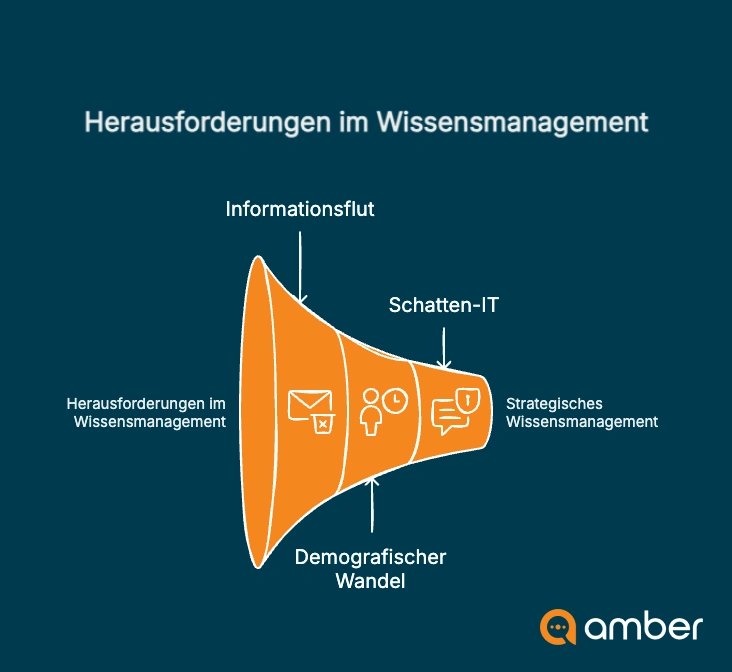
Employees in German companies spend up to 20% of their working time searching for information: an entire working day per week. At the same time, demographic change is leading to the loss of valuable experiential knowledge, while uncontrolled use of AI tools such as ChatGPT is creating new compliance and security risks.
The real problem is not a lack of knowledge. It is fragmented, unstructured, and trapped in silos.
Modern knowledge management solves precisely this problem: It makes existing knowledge findable, usable, and trustworthy across all systems.
In this guide, you will learn:
- why traditional document management fails
- how AI-supported knowledge management works today
- and how companies can finally turn knowledge into a measurable competitive advantage
What is knowledge management? A practical definition
To understand knowledge management, we first need to distinguish between three terms: data, information, and knowledge.
- Data is raw, unstructured facts (e.g., sales figures in a table).
- Information is data that has been put into context (e.g., the realization that sales figures rose by 10% in Q4).
- Knowledge is the ability to interpret and apply information and derive actions from it (e.g., understanding why sales figures rose and how this success can be repeated).
Definition: Knowledge management is the process-oriented and strategic handling of an organization’s entire knowledge base. The goal is to systematically identify, secure, distribute, and efficiently utilize this knowledge in order to achieve the company’s objectives.
A distinction is made between two types of knowledge:
- Explicit knowledge: documents, processes, guidelines, data
- Implicit knowledge: experience, context, decision-making logic in the minds of employees
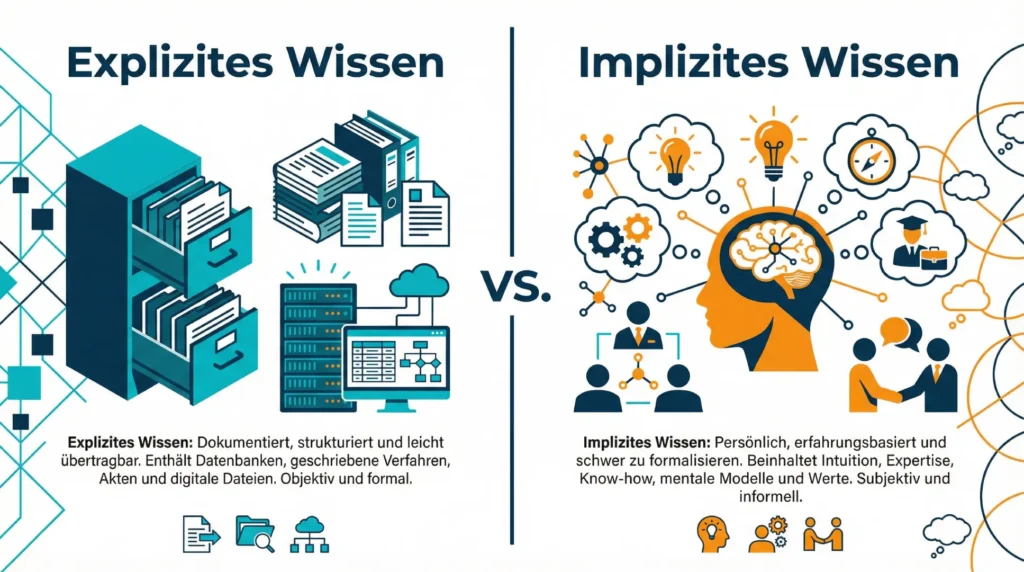
The core problem: Implicit knowledge is lost—through staff turnover, retirement, or lack of documentation.
Effective knowledge management aims to make both types of knowledge accessible and promote the conversion of implicit knowledge into explicit knowledge.
The business case: Why inaction is expensive
Every minute employees spend searching costs productivity, motivation, and money. Even more costly is the loss of experiential knowledge when experts leave the company.
Companies with strategic knowledge management achieve measurable effects:
- Significantly reduced search times
- Faster training of new employees
- Fewer errors due to outdated information
- Better decisions based on reliable knowledge
Knowledge management is therefore not an IT project, but a direct lever for efficiency, innovation, and risk minimization.
| Advantage | Description | Statistical evidence |
| Increased productivity | Reduction in search times, faster training of new employees, and avoidance of duplication of work. | Up to 30% time savings when searching for information and 50% faster training. |
| Innovative strength | Better use of existing know-how for the development of new products, services, and process optimizations. | Companies with excellent knowledge management are up to 25% more innovative, according to studies. |
| Risk minimization | Actively prevent knowledge loss due to employee turnover and ensure compliance through traceable documentation. | In Germany alone, over 6 million skilled workers will retire by 2030. |
| Better decisions | Well-founded strategic and operational decisions through fast and complete access to all relevant information. | – |
Methods and models in knowledge management: An overview
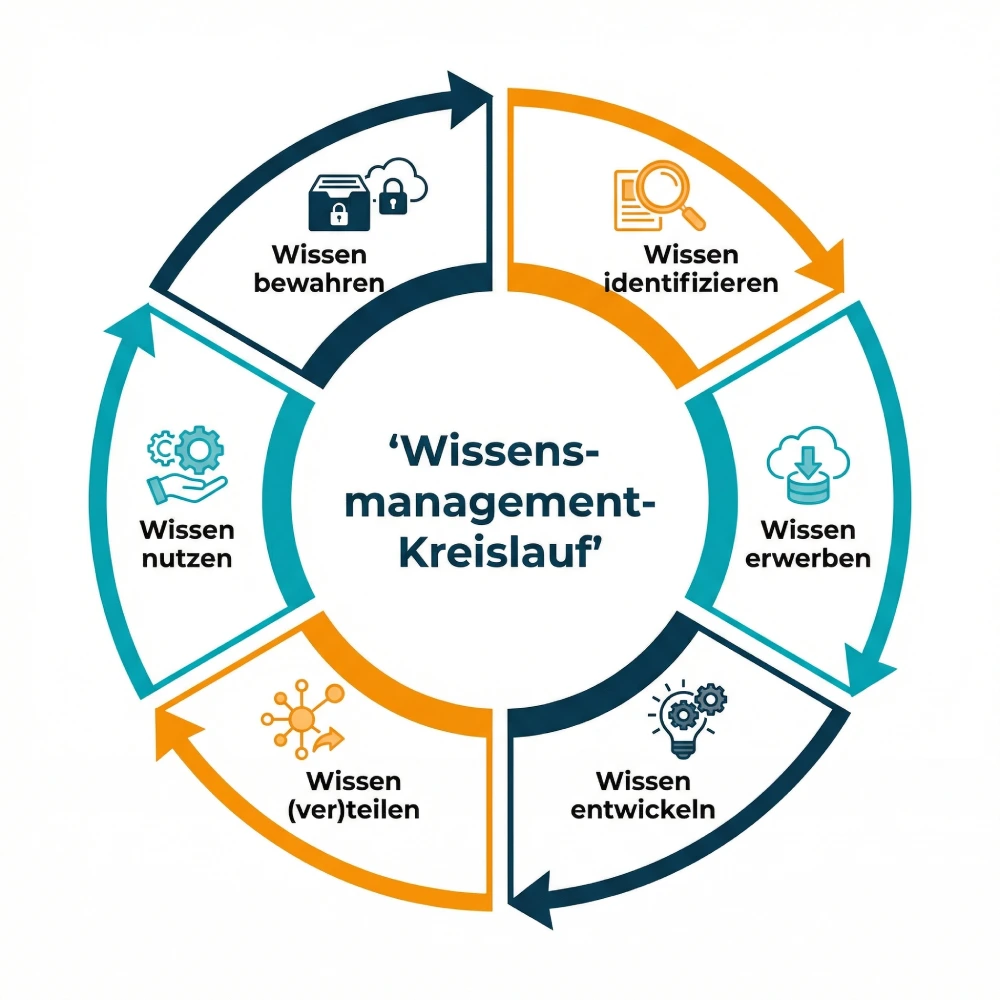
In theory, there are various models, such as that of Probst or the SECI model by Nonaka/Takeuchi. In practice, however, the knowledge management cycle is the most relevant. It describes the six phases that knowledge goes through in an organization and shows how modern technology is revolutionizing each of these steps.
- Identify knowledge: Where is critical knowledge located? In which minds, systems, or documents?
- Acquire knowledge: How can external knowledge (e.g., from markets, competitors) be absorbed?
- Develop knowledge: How can new knowledge be created through collaboration and innovation?
- Distribute knowledge: How is the right knowledge made available to the right employees at the right time?
- Use knowledge: How is it ensured that knowledge is actively applied in processes and decisions?
- Preserving knowledge: How can valuable knowledge be secured in the long term and protected against loss?
Modern AI systems can automate this cycle by, for example, automatically identifying experts, proactively suggesting relevant documents, and bringing together knowledge from different sources in a context-sensitive manner.
The evolution of tools: From wikis to intelligent knowledge platforms
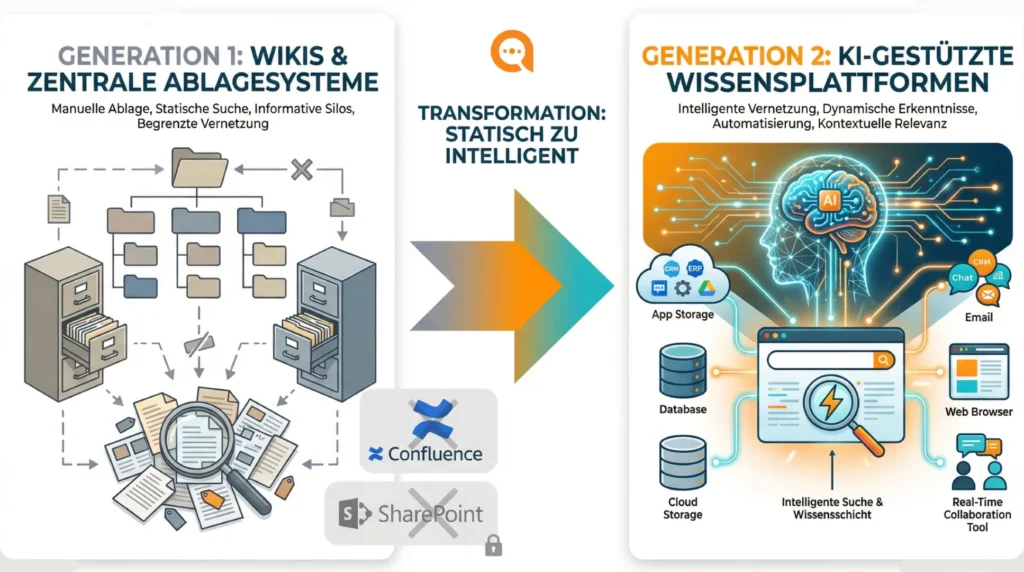
Knowledge management tools have evolved dramatically. Understanding this evolution is crucial to making the right strategic decision for your organization.
- Generation 1: Wikis & central storage systems (e.g., Confluence, SharePoint) These systems function like a library: knowledge must be manually categorized, tagged, and stored. The problem: this approach requires a tremendous amount of manual maintenance, quickly leads to outdated content, and results in a poor search experience. Instead of breaking down data silos, they often just create another poorly organized silo.
- Generation 2: AI-powered knowledge platforms (e.g., amberSearch) The modern approach is fundamentally different. Instead of requiring all knowledge to be migrated to a new tool, these platforms act as an intelligent access layer that sits on top of all existing systems. They leave knowledge where it is created and maintained, whether on file servers, in Microsoft 365, Confluence, or other specialized applications. Technologies such as enterprise search, natural language processing (NLP), and retrieval-augmented generation (RAG) are revolutionizing access to this knowledge. Instead of searching through documents, employees receive precise answers to their questions based on the entire body of secured company knowledge. Technical basics: What is Retrieval-Augmented Generation (RAG)?
Requirements for modern knowledge management software
What really matters in modern knowledge management software
A knowledge platform can only be successful if IT, specialist departments, and management trust it.
It’s not the features that are crucial—it’s these questions:
- Will existing access rights be retained?
- Are AI responses traceable and verifiable?
- Does the solution integrate with existing systems – without migration?
Future-proof knowledge management software must be secure, transparent, and integrable. Anything else is not scalable.
| Criterion | Why it is crucial |
|---|---|
| Connectivity & Integration | The software must integrate seamlessly into your existing IT landscape (cloud and on-premise) in order to eliminate knowledge silos. |
| Security & Data Protection | Compliance with existing access rights is essential. The solution must be GDPR-compliant and ideally hosted in Germany. |
| AI Capabilities | Semantic search, precise answers to questions (Q&A), and the ability to automate tasks are the core elements of an intelligent platform. |
| User-Friendliness | An intuitive interface that does not require extensive training is key to employee adoption. |
| Scalability & Performance | The solution must be able to grow with your company and its data volumes without losing speed or performance. |
| Traceability (Trust) | AI-generated answers must always include source references to ensure transparency, trust, and verifiability. |
6 steps to successful knowledge management: An implementation roadmap
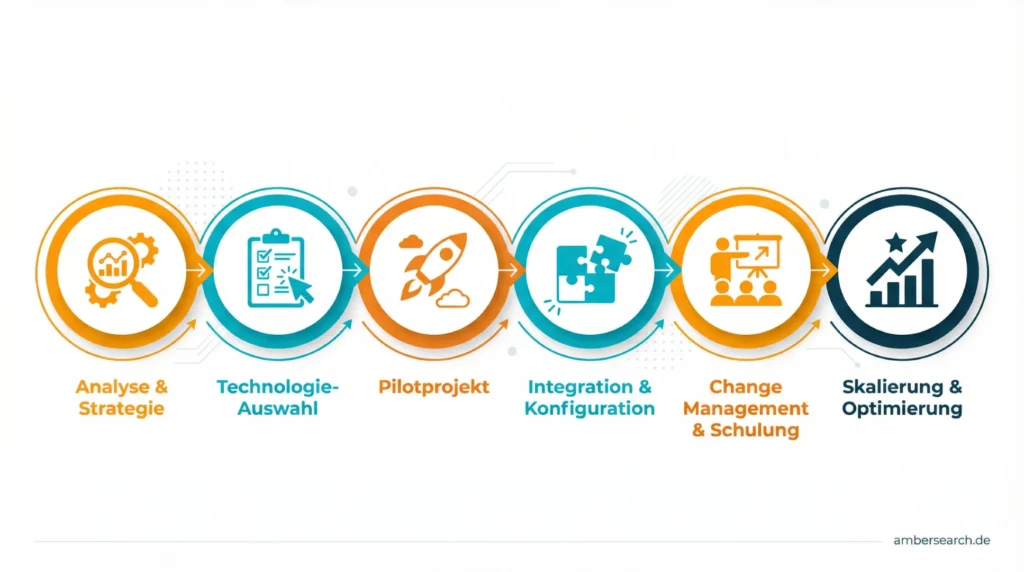
The introduction of knowledge management is not purely an IT project, but a strategic change process. This tried-and-tested 6-step roadmap will guide you safely to success.
- Phase 1: Analysis & Strategy: Define clear, measurable goals (e.g., “Reduce search time in customer service by 15%”). Identify critical knowledge and key stakeholders.
- Phase 2: Technology selection: Evaluate potential software solutions based on your specific requirements (see checklist above). Choose a partner who will support you not only technically, but also strategically.
- Phase 3: Pilot project: Start small and prove the added value. Choose a department or a specific use case with clear pain points (e.g., the sales force, the R&D department, or IT support).
- Phase 4: Integration & configuration: Connect the relevant systems and ensure that the existing rights concept is adopted 1:1. Adapt the solution to the specific needs of the pilot team.
- Phase 5: Change Management & Training: This is the most critical phase. Communicate the benefits clearly and get employees on board. Train users not only in how to use the system, but also in the new way of working. Appoint “knowledge champions” to act as multipliers.
- Phase 6: Scaling & Optimization: After a successful pilot project, roll out the solution step by step throughout the company. Continuously analyze usage data to further optimize the content and the platform.
Practical examples: How companies are already mastering knowledge management with AI today
The theory is convincing, but practice is crucial. Hundreds of German SMEs and corporations are already using AI-supported knowledge management to secure their future viability. Here are three examples:
- Mechanical engineering (ENTECCOgroup): After a merger, ENTECCOgroup faced the challenge of centralizing knowledge from different companies and systems. With amberSearch, a central, intelligent search across all data pools was created, making it possible to find warranty claims and project details from the past in a matter of seconds.
- Food industry (Zentis) : As an international company with a global R&D team, Zentis’ knowledge was spread across different countries and languages. An AI platform, known internally as “zGPT,” was used to create centralized, multilingual access to the entire company’s knowledge, accelerating product development and increasing competitiveness.
- Customer service (DB Regio AG): To improve customer service and reduce the workload on employees, an AI assistant was implemented that automatically answers inquiries from service technicians. This led to a significant reduction in processing times and higher satisfaction among customers and employees. Discover more success stories from your industry
Conclusion: Knowledge is the currency of the future
Digital transformation and demographic change are not distant future scenarios, but are already shaping the reality of German companies today. A passive approach to knowledge is no longer an option. Strategic, AI-supported knowledge management is the decisive lever for increasing productivity, promoting innovation, and securing your company’s most valuable asset—its collective knowledge—for the future. The technology for this is mature, secure, and proven in practice. The next step is up to you.
Start today to turn your company’s knowledge into an active, strategic advantage. Discover how an intelligent knowledge platform can transform your business.
Find answers in seconds – try it free for 30 days
FAQ – Frequently asked questions about knowledge management
What is the difference between knowledge management and document management? A document management system (DMS) is primarily responsible for the structured storage and archiving of documents. Knowledge management is a broader, strategic approach that encompasses the entire knowledge lifecycle—including the implicit knowledge in the minds of employees—and aims to actively leverage that knowledge.
How do you measure the success of knowledge management? Success can be measured by various KPIs, e.g., by reducing search time, faster onboarding for new employees, fewer repeated errors, a higher innovation rate, or improved employee and customer satisfaction.
How do you deal with outdated knowledge? Modern knowledge management platforms help identify outdated information by analyzing usage statistics and flagging documents that have not been accessed recently. A regular review process and clear responsibilities for areas of knowledge are also crucial.
Is knowledge management only relevant for large companies? No, on the contrary. For small and medium-sized businesses in particular, securing expert knowledge and increasing efficiency is vital to remaining competitive. Modern, cloud-based solutions are also cost-effective and quick to implement.
How long does it take to implement knowledge management software? While traditional IT projects can take months, a modern, AI-powered platform such as amberSearch can be implemented within a pilot team in just a few days. The key is an agile, step-by-step approach rather than a big bang rollout.